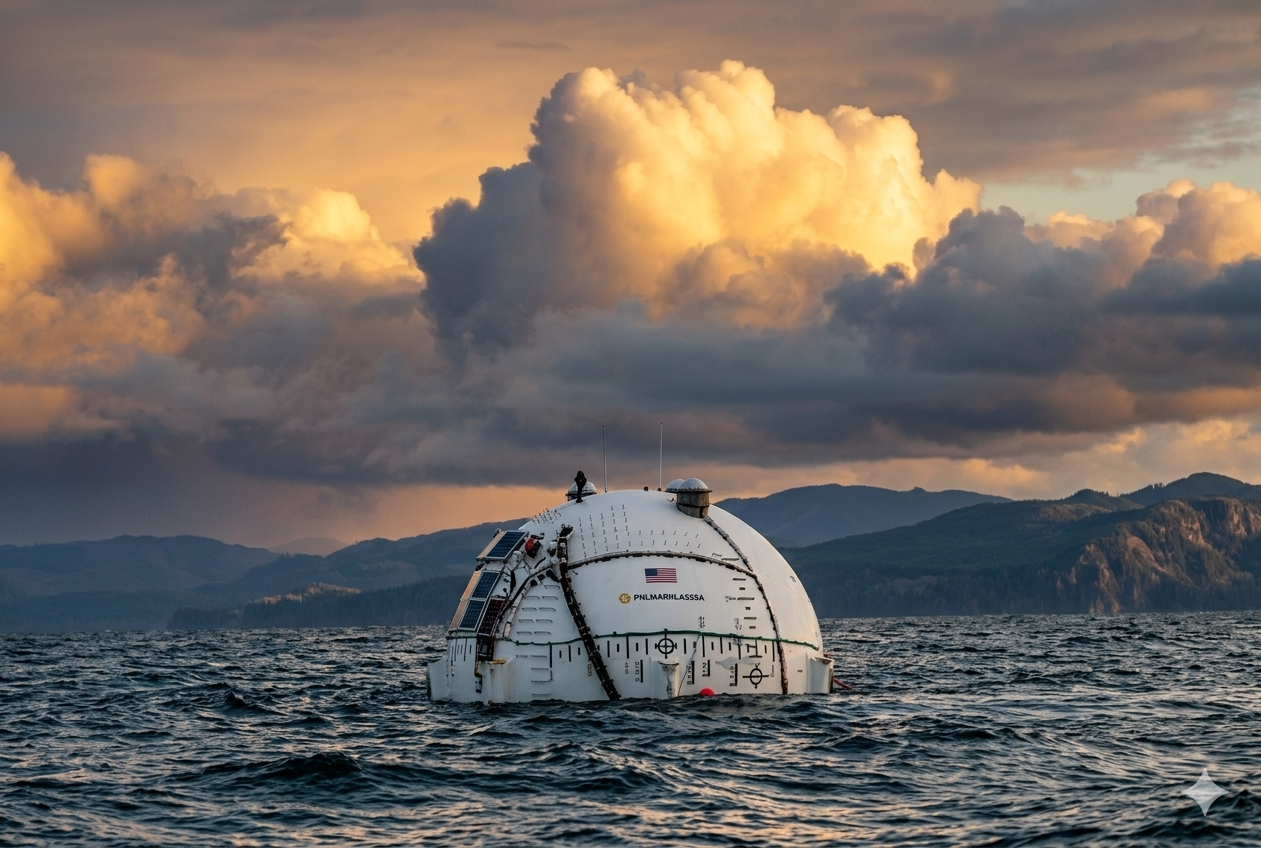
Imagine a lollipop-shaped steel structure, roughly the size of a double-decker bus, floating alone in the middle of the Pacific Ocean — no crew, no cables, no connection to any power grid. It bobs up and down with the waves, converts that motion into electricity, uses that electricity to run AI chips, and beams the results back to shore via satellite. No land. No cooling water. No data centre.
This is not a concept. It has already been tested at sea. And it just raised $140 million to go to commercial scale.
The problem it’s solving
We have written before about how silicon photonics is trying to solve the heat and bandwidth problem inside AI data centres — replacing copper with light at the chip level. But that’s an inside-the-building problem. The outside-the-building problem is just as serious.
Land-based AI data centres are running into hard limits: power grids that can’t keep up, cooling water that communities are running out of, permitting processes that take years, and growing local opposition. A Portland company called Panthalassa looked at all of that and asked: what if we didn’t build data centres on land at all?
How the node works

Each node is a hollow steel sphere connected to a 65-metre tube dangling below it into the ocean. The node bobs up and down as waves pass. That vertical motion drives water up and down the tube, creating pressure that spins turbines inside the sphere, generating electricity. The surrounding ocean provides free cooling — eliminating one of the biggest engineering challenges in land-based data centres. The water recirculates inside the node with no emissions or engines.
My Take — Abhilash Gopinath
The most elegant insight in Panthalassa’s model isn’t the wave energy — it’s the decision to never send electricity back to shore. Every previous ocean energy company tried to cable power to land. Panthalassa skipped that entirely. The power never travels. The AI computation happens right there on the node. Only the result — a few kilobytes of text, image, or data — comes back by satellite.
Yes, that adds latency. Your query travels to a satellite, down to a node in the Pacific, gets processed, and the answer travels back. For real-time conversation, that extra 200ms is noticeable. But Panthalassa isn’t trying to replace your ChatGPT.
Think of it this way: land-based data centres are the front desk — fast, close to you, handling real-time conversation. The ocean nodes are the back office — processing the heavy, non-time-sensitive workloads that don’t need to be instant. Image generation, video rendering, document summarisation, overnight batch processing. Work where waiting a few extra seconds is invisible to the user, but the energy and cooling demands are enormous.
That’s what Panthalassa is really building — a new layer of AI computing capacity that takes the heavy lifting offshore, literally, so land-based infrastructure can focus on what only it can do: be fast and close to people.
The team — and why it matters
This is not a team learning ocean engineering from scratch. The SpaceX drone ship connection is particularly telling — autonomous systems that operate in harsh, remote conditions with no margin for error. That’s the operational DNA Panthalassa is bringing to the open ocean.
What’s next
Commercial deployments are planned for 2027. The $140 million funds completion of the pilot manufacturing facility near Portland and deployment of the Ocean-3 series of nodes in the northern Pacific. The nodes are built from plate steel — earth-abundant, robust supply chains, designed for factory-line mass production. They are towed to sea horizontally, then flip themselves vertical and travel autonomously to their operating location.
The investor list — Peter Thiel, John Doerr, Marc Benioff, Max Levchin — represents some of the most consequential technology bets of the last three decades. They are not betting on incremental improvement. They are betting that the open ocean becomes a meaningful piece of the world’s AI computing infrastructure.
Sources: Business Wire — Panthalassa Series B · Oregon Live · GeekWire · Financial Times
Related posts:
 What Happens When Your AI Negotiates For You — And The Other Side Has a Better One?
 The Light Inside the Machine — How Photonics Is Becoming the Nervous System of AI
 Stanford 2026 AI Index — AI is Sprinting and the Rest of Us Are Finding Our Shoes
 Ghost Murmur — How the CIA Used Quantum Technology to Rescue a Downed Pilot from 40 Miles Away
Comments
One response to “AI at Sea — The Startup That Wants to Power the Future with Ocean Waves”
Panthalassa’s ocean-based nodes – one of best growing trends. The non-land based data centres and it’s working principle – so fascinating. The article is so specific about the idea of its opportunities in sustainable designing that overcomes the limitations of space, energy and water usage on land.