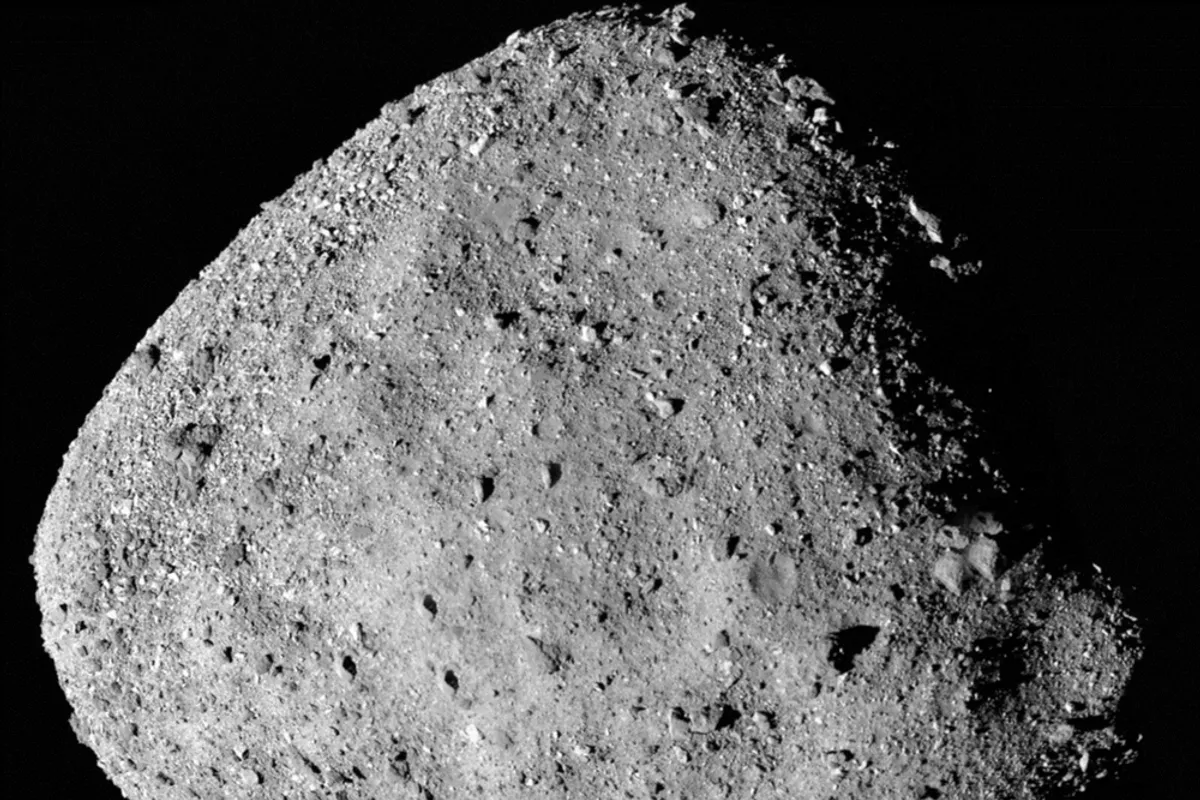
“I personally consider the OSIRIS-REx mission to Bennu as the most precise activity in the history of human spaceflight — more complex than even the moon landing. Here is why.”
— Abhilash Gopinath, Fanlumin
Bennu is a diamond-shaped, boulder-covered asteroid about one-third of a mile wide, formed 4.6 billion years ago — before Earth existed. It orbits the sun every 1.2 years, passes close to Earth every 6 years, and was discovered on September 11, 1999. A third-grader named Michael Puzio named it “Bennu” through a NASA contest in 2013.
In 2016, NASA launched a spacecraft to go and touch it. And bring a piece of it home.
The Timeline
Scientists tracked Bennu from 1999 through 2012, mapping its shape, rotation, and mass from Earth. NASA’s OSIRIS-REx launched September 8, 2016, arrived at Bennu in late 2018, and spent two years mapping every boulder and crater — discovering, to everyone’s shock, a chaotic rubble pile instead of the sandy landscape expected. The sampling strategy had to be completely redesigned in deep space. The spacecraft collected a sample on October 20, 2020, departed May 10, 2021, and delivered the capsule to Earth on September 24, 2023.
Why This Is More Precise Than the Moon Landing
On October 20, 2020, OSIRIS-REx performed TAG — Touch-And-Go Sample Acquisition. The spacecraft descended autonomously toward Bennu’s surface. With an 18-minute communication delay between Earth and the spacecraft, no human could intervene in real time. No joystick. No override. Every decision made by the spacecraft itself.
It extended a robotic arm, fired a burst of nitrogen gas to stir up loose material, collected the disturbed debris in under 10 seconds of contact, then fired its thrusters and retreated.
Bennu rotates constantly. Its gravity is so weak a person could jump off it into space — yet still strong enough to affect the spacecraft’s approach. The target area was the size of a few parking spaces, surrounded by boulders that could destroy the mission instantly.
Then a crisis: the sample head collected 121.6 grams — double the mission requirement — jamming the lid open. Precious 4.6-billion-year-old material was leaking into space. Engineers redesigned the stowage procedure in real time. It was executed flawlessly.
Question from Abhilash Gopinath
How did the collector put the samples back into the capsule? Did the collector itself become the capsule, or was there a handover to the capsule before it flew back?
Answer
The TAGSAM Head — Collector and Container in One
The collection mechanism was called TAGSAM — Touch-And-Go Sample Acquisition Mechanism. It was essentially a round, flat disc — like a large air filter — attached to the end of a robotic arm. When it touched Bennu’s surface, it fired a burst of nitrogen gas that stirred up loose material, and that material was sucked up and trapped inside the TAGSAM head itself. So the head was both the collector AND the initial container — there was no separate “scooping into a bag” moment. The material went directly into the head and stayed there.
The Transfer into the Return Capsule
After collection, the robotic arm retracted and stowed the entire TAGSAM head inside the Sample Return Capsule (SRC) — the heat-shield-protected pod that eventually re-entered Earth’s atmosphere. Think of it like this: TAGSAM head = the collecting cup. Sample Return Capsule = the sealed thermos that goes home. The cup was placed inside the thermos and sealed shut.
The Crisis — Why This Matters
The TAGSAM head collected so much material (121.6g) that rocks and debris were wedging the head’s mylar flap open — material was floating out into space. Engineers had to instruct the spacecraft to skip the normal weight measurement step and immediately stow the TAGSAM head into the SRC and seal it before more material was lost. It worked. The SRC sealed successfully, locking everything inside for the two-year journey home.
So to directly answer your question: The collector (TAGSAM head) did not become the capsule — it was placed inside the capsule. But there was no manual transfer of individual samples. The entire head, with material inside, was stowed as a unit into the sealed return capsule. Scientists on Earth then opened the capsule, removed the TAGSAM head, and extracted the samples in a clean room at NASA’s Johnson Space Center.
The Journey Back
On September 24, 2023, the spacecraft released its sample capsule over Earth’s atmosphere. It re-entered at 27,000 mph, generating around 5,000°F on its heat shield — hotter than the surface of the sun. The entry window was razor-thin: too steep and it burns up, too shallow and it skips back into space forever. Thirteen minutes later, it parachuted safely into the Utah desert.
The spacecraft was renamed OSIRIS-APEX and redirected toward asteroid Apophis, arriving in 2029.
What They Found — The Findings That Rewrote Everything
14 of the 20 amino acids that life on Earth uses to build proteins. All 5 nucleobases found in DNA and RNA. Evidence of ancient saltwater — a chemical broth where these compounds could interact and combine. An unexpected phosphate mineral hinting that Bennu may have splintered from a primitive ocean world that no longer exists.
Then in late 2025, three more papers arrived. Ribose and glucose — sugars essential for RNA. “Space gum” — a polymer never before seen in any astromaterial, soft like chewed gum billions of years ago, now hardened into brittle ancient plastic. And stardust — microscopic grains forged inside supernovae that exploded before our solar system existed, at six times the normal concentration.
None of this proves life exists elsewhere. But it suggests the chemical conditions for life to emerge were not unique to Earth. They were widespread. Ordinary, even.
One mystery haunts everything. Bennu’s amino acids are an equal mixture of left-handed and right-handed versions. Life on Earth almost exclusively uses left-handed. Why life “turned left” remains one of the deepest unsolved questions in science.
Why I Consider This the Most Precise Activity in Human Spaceflight
The moon landing was extraordinary — but the moon is large, predictable, and gravitationally cooperative, with humans onboard to adapt. OSIRIS-REx had to autonomously touch a fast-rotating boulder field the size of a stadium, 200 million miles away, with no possibility of human correction, collect pristine material without contaminating it, seal a leak in deep space, and return it through a 5,000°F re-entry to land in a Utah desert — all while carrying a time capsule that may contain the answer to the greatest question humanity has ever asked: how did life begin?
That is a different kind of precision entirely.
Sources:
NASA Science — Bennu ·
NASA Exploration ·
Nature Astronomy (Jan 2025) ·
Nature Geoscience (Dec 2025)
