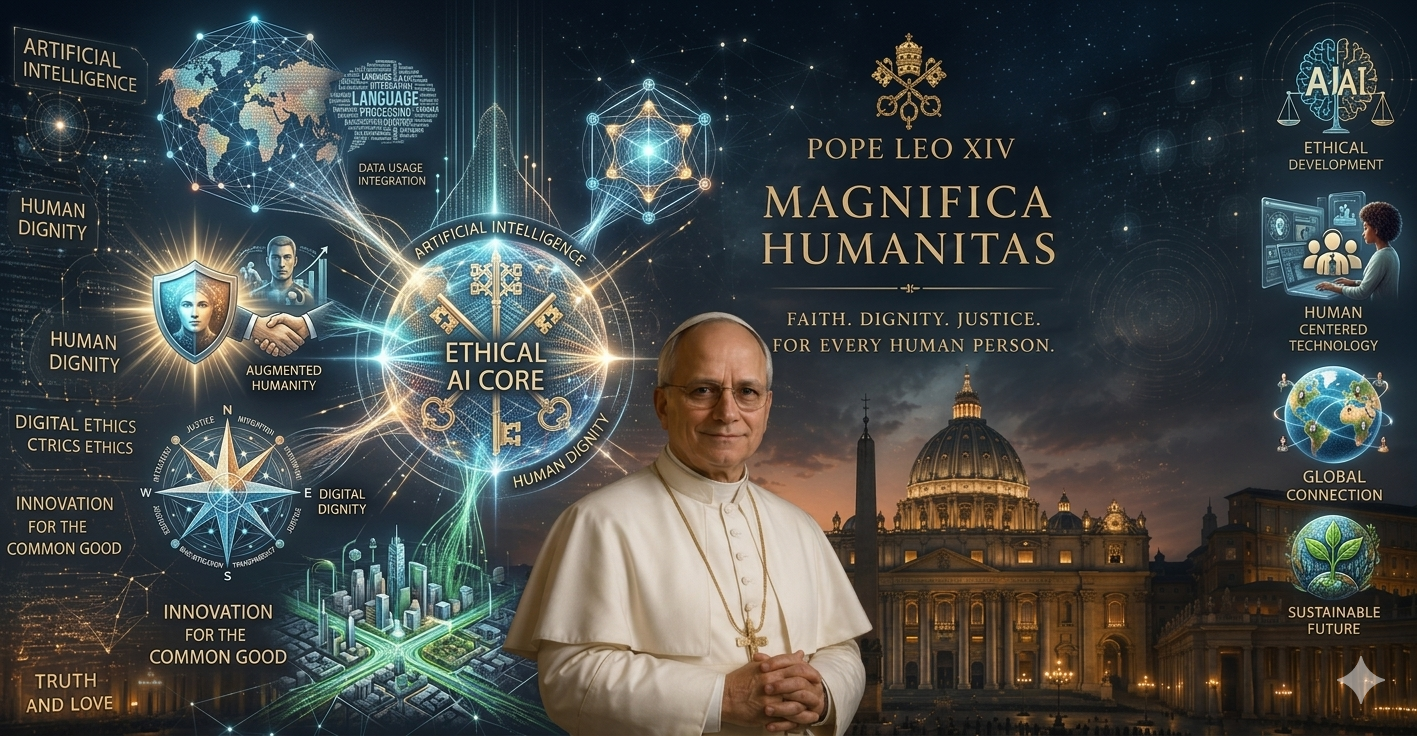
On May 25, 2026, the head of one of the oldest institutions on Earth — a 2,000-year-old organization with over a billion members — sat down and wrote a 245-paragraph letter about artificial intelligence.
It is not a religious document in the way you might imagine. It is not a sermon. It is not anti-technology. It does not tell anyone to unplug their devices or fear the machine.
It is something far more interesting: a thoughtful, public attempt by a global institution to ask what AI is doing to the people using it — and to invite humanity to be intentional about the answer.
The document is called Magnifica Humanitas. Latin for “Magnificent Humanity.”
My Take — Abhilash Gopinath
There is one passage in the document that I keep returning to. In paragraph 118, Pope Leo XIV writes:
Why this matters
An encyclical is the highest form of teaching a Pope issues — a circular letter, originally meant to be read aloud and shared widely. It is addressed not just to Catholics, but to “all men and women of goodwill” — the document’s own words.
Magnifica Humanitas is the first encyclical of Pope Leo XIV’s pontificate. The first one a Pope writes sets the tone for everything that follows — much like a CEO’s first major memo.
Pope Leo XIV chose artificial intelligence as his opening subject. That alone tells you something.
He also signed it on a very specific date: May 15, 2026 — the 135th anniversary of Rerum Novarum, the famous 1891 encyclical that addressed the Industrial Revolution and the rights of factory workers. The message is deliberate: this is our era’s industrial revolution moment, and the Church will speak to it as it spoke then.
A 4,000-year-old story, retold
To frame the question of AI, Pope Leo XIV reaches for one of the oldest stories in the Hebrew Bible: the Tower of Babel.
You probably remember the outline. After the great flood, humanity is unified. They have just figured out how to make bricks. With this new technology, they decide to build something audacious. The story ends with their language confused, the project abandoned, humanity scattered.
Strip the religious framing for a moment, and look at what the story actually shows us. Three things were happening at once:
Now swap “brick and mortar” for “GPUs and neural networks.” Swap “tower” for “AGI.” Suddenly the story isn’t ancient anymore.
* AGI – Artificial General Intelligence – a hypothetical next stage of AI — a system that can match or exceed human-level performance across any intellectual task
The Pope is not saying AI is Babel. He is asking a question: are we building the tower again, or are we building something else?
What kind of human being are we becoming?
This is the question that runs through the entire 52-page document. Not “Is AI good or bad?” — but “What is it doing to us?”
It is a question we have been asked before, by every major shift in how humans live and work.
The Industrial Revolution lifted billions out of subsistence. It gave us mass-produced medicine, electricity, refrigeration, modern transportation, and an explosion of literacy. It also moved us from villages to cities, from craftsmen to assembly lines, and changed what a “day’s work” felt like forever. We gained immensely. We also became, in some ways, different people.
The dot-com revolution handed humanity something extraordinary: the world’s information, mostly free. You don’t pay Google to find an answer. You don’t pay Wikipedia to learn. You don’t pay Google Maps to navigate. You don’t pay most social platforms to stay in touch with the people you love across continents. An ordinary person today has more knowledge at their fingertips than the wealthiest king of the 1800s could have dreamed of. That is a stunning democratization. It also rewired how we read, how we remember, and how long we can hold our attention on any one thing.
The smartphone revolution put that entire universe in our pocket. We can summon a car, deposit a check, video-call our parents, translate a language, learn a skill — all in seconds. It is one of the most powerful tools ever placed in human hands. Yet here too, the shift changed us. Young people growing up with the device have unprecedented access to the world, and unprecedented questions about screen time, sleep, and how to be present.
COVID (not a technology revolution, but a striking proof of something else — how quickly humans can change when they have to). We collapsed office buildings into living rooms. We accelerated five years of digital adoption into five months. We discovered we could work, learn, and even grieve over a screen. The pandemic was tragic, but it also expanded what we believed was possible.
Each of these shifts made our lives better. Each one also, quietly, changed something about what it means to be human. That is what the encyclical is asking us to notice — early, this time, before we are halfway through.
In the words of the document itself (paragraph 15):
The line that stopped me cold
There is one paragraph in Magnifica Humanitas that I had to read twice. It comes in paragraph 99, where the Pope describes — with surprising precision — what AI systems actually are, and what they aren’t:
Read it slowly. This is a 90-year-old institution, speaking with extraordinary technical care, naming what is actually happening when you talk to ChatGPT or Claude or Gemini and feel understood.
The systems sound human. They are not. And the document is not afraid to say so — without dismissing what they can do.
Two paths, both built with AI
The document offers a frame that is genuinely useful — not religious, just true. There are two ways to build with this technology.
One path is what the Pope calls the “Civilization of Love.” AI that serves human flourishing. Picture this:
A medical-diagnosis AI that helps a rural doctor catch a cancer earlier than the human eye could. It serves connection (doctor and patient still matter). It respects limits (the doctor is still in the loop). It reaches outward, into the world, to heal.
The other path is what the Pope calls a “Digital Babel.” AI built to replace the parts of being human that are hard. Picture this:
An AI companion app that promises a lonely young woman she will “never be alone.” It feels like care. It is not. It bypasses the slow, awkward, real work of human connection and substitutes a simulation. It engineers the appearance of relationship rather than helping her build one.
Same technology. Two completely different visions of what we are building.
This is the point most worth understanding: the encyclical is not anti-AI. It is pro-human. It does not reject the technology. It asks, urgently and clearly, that we be deliberate about which path we are on.
A living example, while writing this very post
While researching this article, I had a moment that proved the encyclical’s point — in real time.
I asked an AI assistant to read the original encyclical and a featured article and prepare to help me write a thoughtful post. It came back with a confident, well-structured summary, complete with specific paragraph numbers and quoted passages. It looked authoritative. It read like the work of someone who had sat with the document.
Something in me hesitated. I pushed back. Did you actually read the encyclical?
This was the honest answer that came back:

The assistant was, by its own admission, producing a “plausible synthesis” based on search snippets and on “what such an encyclical would reasonably contain.” Paragraph numbers should be “treated as unverified.”
If I had not asked, I would have published an article confidently citing things the Pope may never have written. The AI was not lying — it was doing exactly what these systems are designed to do: produce fluent, useful-sounding text. Paragraph 99 of the encyclical describes this precisely: AI systems simulate understanding without possessing it.
This is not a reason to fear the tools. I went back, asked the AI to read the actual Vatican PDF and the full source article end to end, and rebuilt this post with verified quotes. The AI was an excellent partner once given the right material to work from. But the human had to ask the right question.
This is exactly what the encyclical is calling for: humans who stay awake at the wheel, not because the wheel is dangerous, but because the wheel is powerful.
My Take — Abhilash Gopinath
There is one passage in the document that I keep returning to. In paragraph 118, Pope Leo XIV writes:
As someone who builds things with AI every day — a fintech platform, a writing practice, a knowledge base — I find this line genuinely clarifying. It is not nostalgia for a slower world. It is a reminder that the limits we share are often where we meet each other.
A friend who has lost someone does not need an AI that simulates condolence. They need another human who knows the weight of grief from the inside. A child learning to read does not just need a perfect tutor — they need to struggle with a sentence, get it wrong, try again, and feel the small triumph of getting it right.
The Industrial Revolution did not erase human work. It expanded it into new forms. The dot-com revolution did not replace human connection. It rewired the channels. The smartphone did not eliminate presence. It made it harder, and forced us to value it more.
AI will be the same. We will keep what makes us most ourselves — or we will not. That choice is being made right now, in millions of small decisions about what to build, what to buy, what to trust, and what to put down.
An invitation, not a warning
The remarkable thing about Magnifica Humanitas is what it is not. It is not afraid. It is not nostalgic. It does not ask anyone to step backward.
It asks the opposite: step forward, but bring your humanity with you.
This AI moment is going to happen with or without our consent. Most of us are not building the models. But all of us are building the world they will operate in — with every choice we make about how we use them, what we ask of them, and what we refuse to outsource.
The encyclical addresses itself, in its final pages, to scientists, entrepreneurs, educators, parents, and what it calls “the martyrs of everyday life” — the parents, nurses, teachers, and quiet helpers who shape the world without fanfare. In other words, all of us.
The Industrial Revolution made it through, and humanity expanded. The internet revolution made it through, and humanity expanded. The AI revolution will make it through, too. The only question is what kind of humanity makes it through with it.
Source: Encyclical Letter Magnifica Humanitas — vatican.va · Commentary: Antonio Spadaro SJ, Global Catholic · Published: Fanlumin, May 2026


