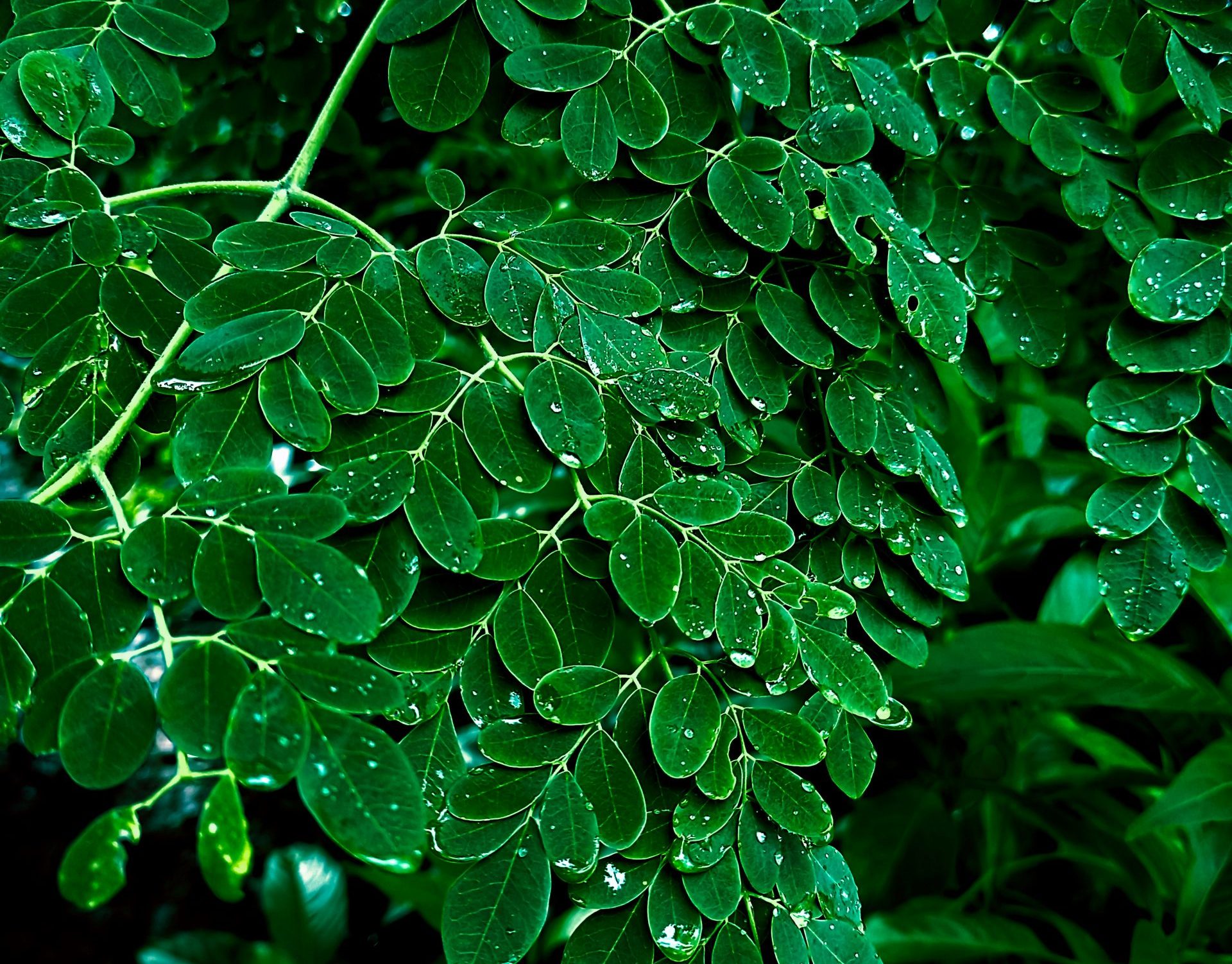
Microplastics are found in 83% of tap water tested globally. They are now inside human brains, reproductive organs, and cardiovascular systems. A new study from Brazil and the UK found that seed extracts from the Moringa tree remove 98.5% of microplastics from tap water — matching industrial chemical treatments, and outperforming them in alkaline water. This is the culmination of more than a decade of research by the same team.
Why microplastics are hard to remove
Microplastics carry a negative electrical charge — they repel each other, stay suspended in water indefinitely, and resist conventional filters. The solution is coagulation: a substance that neutralises that charge, causing particles to clump into larger masses that can be filtered out. The question is which coagulant to use — and what it leaves behind.
Why Moringa — out of everything in nature?

Not a random choice. Over a hundred natural coagulants have been systematically compared across multiple global studies — Moringa oleifera consistently came out on top. It was directly tested against Benincasa hispida, another strong natural coagulant, and outperformed it. The same research group spent a decade proving Moringa works across the full treatment cycle before testing it on microplastics specifically. Ancient Egyptians, Greeks, and Romans used Moringa seeds to purify Nile water thousands of years ago. Modern science didn’t discover it. It finally measured it.
My Take — Abhilash Gopinath
What struck me most is not the 98.5% efficiency — it’s the journey. A tree used by ancient Egyptians along the Nile, tested against over a hundred modern alternatives, and proven to outperform industrial chemicals that cost money, leave toxic residue, and require supply chains most of the world doesn’t have.
We assume solutions to modern problems must be modern inventions. They don’t. Before we wait for infrastructure and regulation to catch up — a steel container, a handful of seeds, and two hours of patience is a real solution available today.
And for anyone from South Asia — you probably already know this tree as the drumstick plant sitting in your grandmother’s backyard. 😊
Question — Abhilash Gopinath
How did researchers narrow down Moringa from everything else in nature?
Answer
Moringa wasn’t a guess — it was a winner. More than a hundred natural coagulants have been systematically compared worldwide and Moringa consistently came out ahead. A direct test against Benincasa hispida confirmed its edge. A decade of prior work by the same team established it works across the full treatment cycle. Ancient civilisations arrived at the same conclusion independently through centuries of observation. Modern science didn’t discover Moringa. It finally measured it.
Question — Abhilash Gopinath
What is it about Moringa seeds that makes them work — is the mechanism understood?
Answer
Completely. Moringa seeds contain small, positively charged proteins. Microplastics carry a negative charge. The proteins bind to the microplastic particles, neutralise their charge, and trigger polymer bridging — acting as molecular glue that holds clumps together until they are large enough to sink or be caught by a filter. The chemistry is well understood at a molecular level.
Question — Abhilash Gopinath
If the mechanism is understood, why not just synthesise the active ingredient artificially and skip the tree?
Answer
You could — but synthetic coagulants already exist and they leave behind residual aluminium linked to neurodegenerative disease, chemically contaminated sludge, and require supply chains most of the world can’t access. Moringa’s advantage isn’t that its chemistry is unique. It’s that the chemistry comes packaged inside a tree that grows itself, for free, in exactly the regions that need affordable water purification most.
Starting at home
One seed treats 10 litres. Grind dried kernels into powder, mix with salted water to extract the proteins, add to your water, stir fast for two minutes then slowly for 15, let rest undisturbed for one to two hours. Draw clear water from above the sediment — a tap 20% above the base works well.
Sources: CNN · ACS Omega — original research paper · Science Daily · NIH — Moringa protein comparative study